Open weights require an operating layer
Model choice, customer data control, and deployment flexibility become operational only when policy and routing remain independent of any one model.
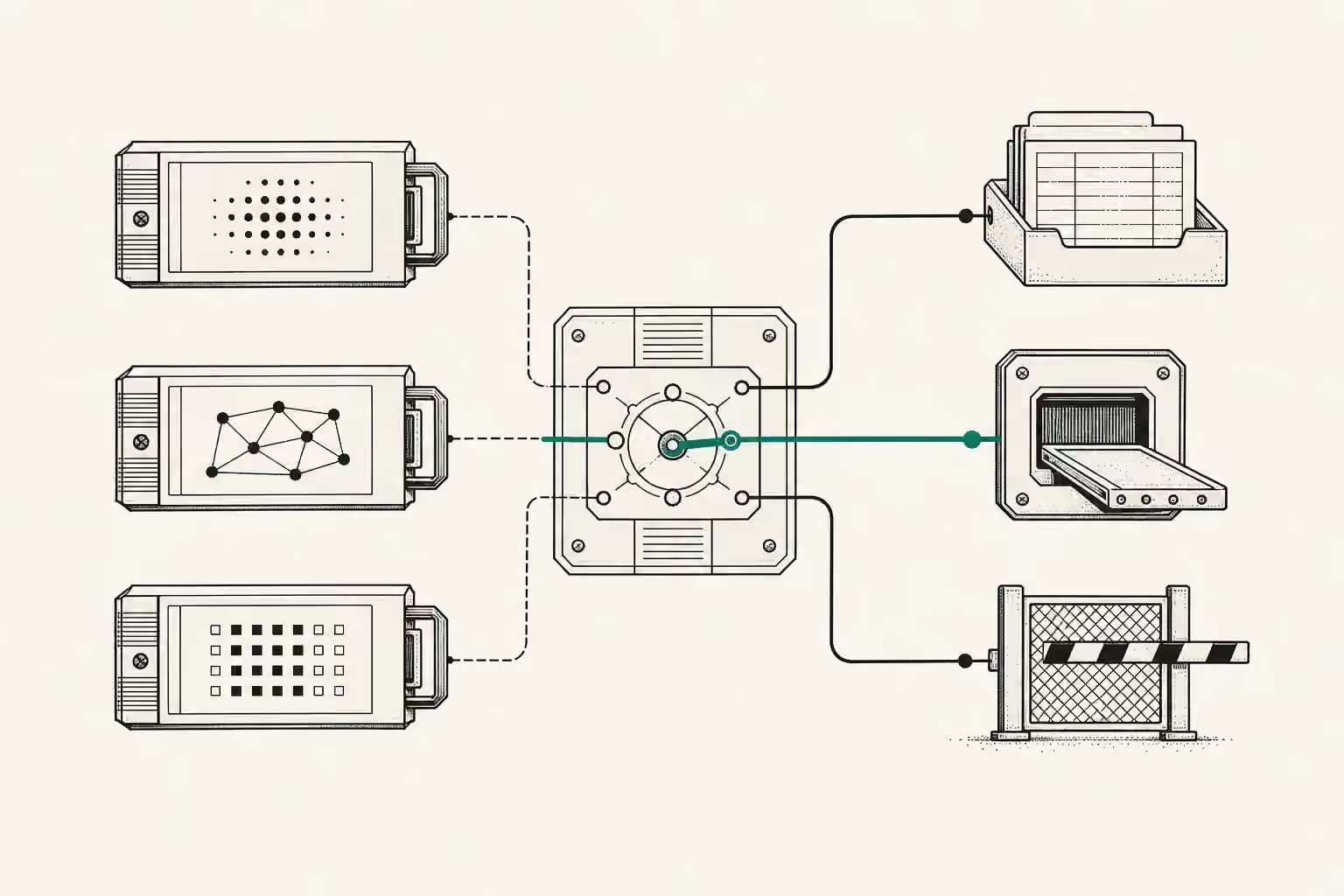
Model choice creates an operating requirement: the rules for data, routing, evaluation, and deployment have to survive a model change. Microsoft’s July 24, 2026 policy statement makes the demand visible. Organizations want to match models to jobs and costs, retain control of customer data, adapt models, and deploy them where their requirements lead. A model-independent operating layer turns those choices into repeatable practice.
An operating layer is the software around models that supplies policy, context, tools, routing, tests, and records. Model-independent means those controls do not have to be rebuilt when an organization adds or replaces a model. An open-weight model, in the statement’s definition, makes its learned parameters available for people to download, inspect, modify, and run on infrastructure they choose.
Choice needs a place to become policy
The statement argues that open weights let an organization match “the right model to the right job at the right cost”. That choice remains theoretical until a production system can act on it. A route needs an approved model list, a task classification, an evaluation threshold, a cost rule, and a record of which path ran.
Those controls belong above the model boundary. Put them inside one provider-specific integration and every substitution becomes a policy migration. Keep them in the operating layer and a team can change the selected model while preserving the rule, the test, and the resulting record.
Microsoft’s statement extends the competition argument beyond model developers to cloud chips, applications, and services. That wider field increases the number of combinations an operator may need to evaluate. It does not remove the obligation to decide which combination is approved for a given workload.
Data control has to follow the request
The statement says organizations want to avoid lock-in and retain the knowledge and capabilities they build. It presents open weights as one way for customers to control their own data, evaluate and adapt models to their needs, and deploy them wherever business requirements demand.
Each verb implies an operating control. Data policy determines which context a request may carry. Evaluation determines whether an adapted model is ready for a bounded job. Deployment policy determines which environment may process a workload. A routing decision has to respect all three at once.
This is why a menu of models is insufficient. The valuable mechanism is the policy-bound route from request to approved model to recorded result. When that mechanism is independent of the selected model, control can follow the work rather than depend on a vendor’s default.
Flexibility increases the testing surface
Replaceable and adaptable models create more paths to test. The statement acknowledges that released weights can be modified and can become difficult for the original developer to trace or reverse. It also argues that open models let a broader community examine behavior, identify vulnerabilities, develop safeguards, and improve models, including through benchmarking, evaluation, and red teaming.
That is an argument for broader scrutiny, not evidence that every modified model is safe. An operator still needs a gate that binds a model version to an evaluation, an allowed deployment, and a rollback decision. The operating layer is where that evidence can remain comparable while implementations change.
The page is a policy advocacy statement signed by 25 organizations. It reports no measured adoption, customer outcome, or production case study, and it does not prove that organizations have implemented the architecture argued for here. Microsoft and the other signatories are public evidence, not Muniment customers or endorsers. Their statement is useful for a narrower reason: it records demand for choice, control, and deployment flexibility. Meeting that demand is an operating-layer job.
Sources
- Microsoft: Open weights: Open innovation for the future of AI www.microsoft.com