The operating layer is becoming an owned asset
Operating reports and executive interviews agree. Keep the workflow, evaluation, routing, and cost controls under your authority while models change.
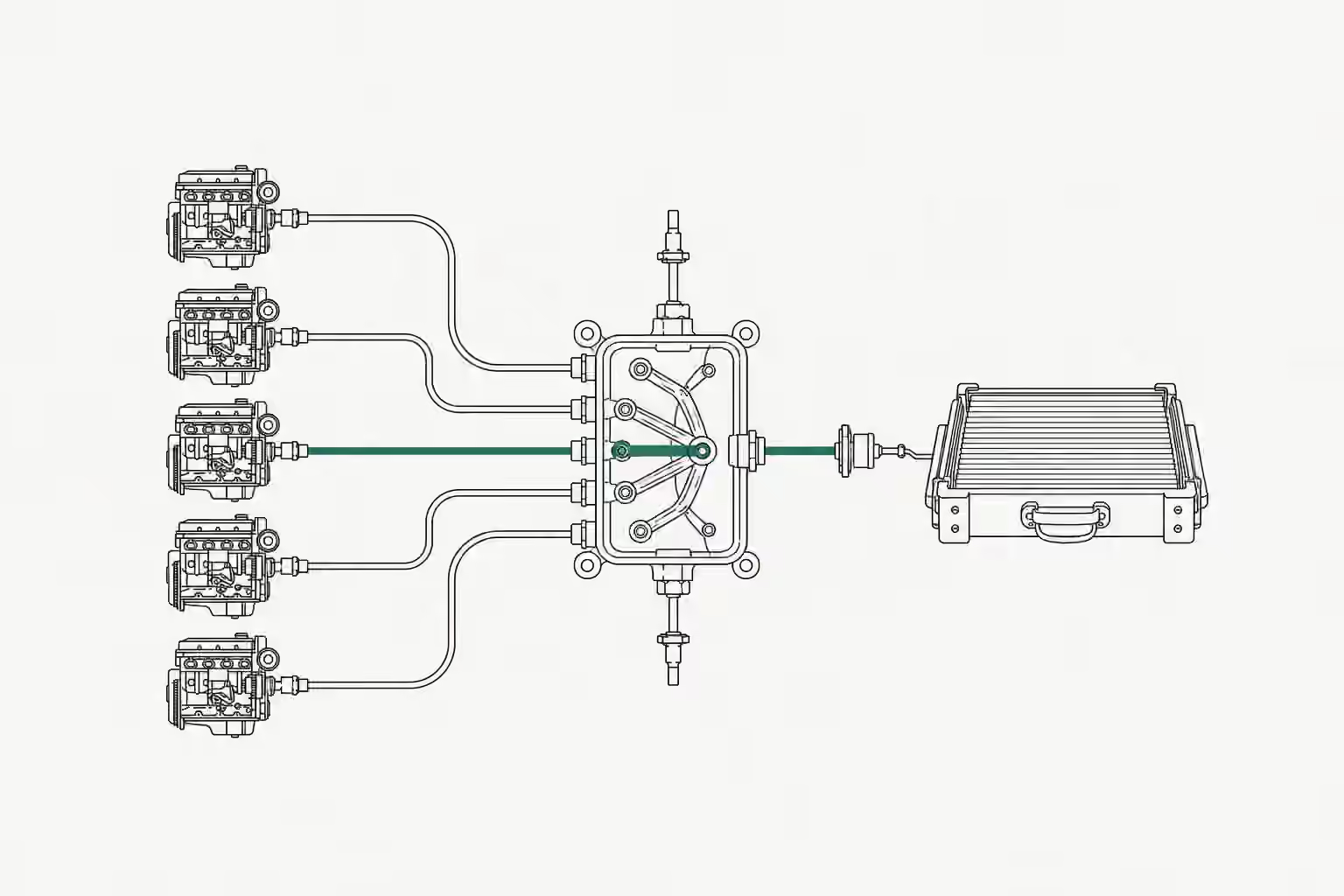
The durable asset is the operating layer around a model: the workflow, evaluation, routing rules, and cost record that remain useful when the model changes. Public operating reports show teams building that layer now. A separate set of executive interviews makes the ownership case from four directions. Together they describe an organizational capability, not a better model shopping list.
Start with the work, then make it repeatable
Uber’s Agentic Pods begin beside the person doing the work. Its public report says each pod paired one of about 30 engineers with deep knowledge of Uber’s systems with a business-domain expert, then gave the pair two weeks to observe, prioritize, build, validate, and ship. Uber reported 16 pods across 16 business functions in two months.
The homepage proof band carries one result from that report: Uber says a capital-allocation workflow covering 150 cities fell from 15 hours to 30 minutes. Here, the useful unit is the workflow. A fast answer has little value if nobody has captured the steps, the domain judgment, and the test for whether the result works for more than one practitioner.
DoorDash shows the next discipline. Its code-review system separates discovery from verification: a lead scout flags suspicious parts of a change, then deeper reviewers investigate the strongest leads and discard claims that do not hold up. DashBench gives that arrangement a fixed test instead of judging it from whichever comments developers happen to accept.
The published model-mix comparison uses the same frozen 105-case set, context, prompts, output contract, and grading path. Its compact record is the other operating result summarized on the homepage:
| Configuration | Pattern | Weighted precision | Weighted recall |
|---|---|---|---|
| Kimi K2.6 scout + Claude Fable 5 reviewer | Staged | 89.2% | 65.2% |
| GPT 5.5 high reviewer | Single pass | 84.1% | 30.7% |
| Claude Opus 4.8 high reviewer | Single pass | 89.8% | 20.2% |
Those figures belong to DoorDash’s report and its benchmark slice. The staged configuration also recorded 75.3% weighted F1. They do not rank models everywhere. Here, the transferable mechanism is the one DoorDash can keep: discover, verify, measure, and replace components without abandoning the test.
Control is moving up the stack
Alex Karp put the ownership demand bluntly in a July 1 CNBC interview at 3:36: technical customers want “control over their compute, their models, their data stack and their alpha.” Palantir’s nine-point statement published the day before argues for institutional control of data, model weights, and the distinct knowledge that produces an advantage. That statement uses Palantir’s own charged vocabulary. The narrower operational point is enough: outsourcing a component should not mean surrendering the ability to inspect, replace, or measure it.
Satya Nadella describes the corresponding architecture inside Microsoft. In his June 4 Stratechery interview, he says Microsoft has “the same harness that’s a multi-model harness in which we will rotate through.” A harness is the software around a model that supplies context, tools, tests, and controls. Nadella says the same harness spans GitHub, security, and Cowork while accepting several model families and models an organization builds or tunes itself. He later calls automatic routing among those choices one of Microsoft’s biggest areas of work.
The often-repeated line that the model is not the product and the harness is comes from a commentator’s paraphrase. It is not Nadella’s quote. His actual remarks are more useful because they name the operating behavior: keep a common harness, rotate models through it, and let evaluation decide.
Ownership has an adoption path and a cost curve
Clément Delangue describes ownership as a progression rather than a starting requirement. In a TechCrunch Equity interview, he says companies often begin with frontier model APIs, then move toward models they control as their use and costs grow. At 6:00, he frames the choice directly: companies want to own their models rather than rent them. TechCrunch reports that Hugging Face is used by roughly half of the Fortune 500, and Delangue distinguishes an “LLM API bubble” from the broader field at 31:56.
Eno Reyes supplies a unit-cost view from Factory’s harness work. In a LangChain Max Agency interview, Reyes says a comparable code-review task cost about $1.70 in one harness and $5 to $6 in others. That is his example, not a universal price. He says aggregate model spending can reach tens or hundreds of millions of dollars inside one enterprise, then identifies automatic model routing as the largest saving available in many cases.
Routing changes the cost question from “Which model is cheapest?” to “Which model is sufficient for this step?” The answer can differ between finding a possible issue, checking it, and writing the final record. DoorDash’s staged reviewer makes that separation visible. Nadella describes the common harness that can act on it. Reyes puts a price on ignoring it.
None of the people or companies cited here is a Muniment customer or endorser. These are public statements and operating reports, not product claims. Their agreement is still consequential: the replaceable part is getting more capable, while the surrounding judgment, tests, routes, and records are becoming the part an organization needs to own.
Sources
- Praveen Neppalli on X: Uber Agentic Pods operating report x.com
- DoorDash Engineering: How we learned to trust our AI code reviewer at DoorDash careersatdoordash.com
- CNBC: Palantir CEO Alex Karp says 'something has gone completely wrong' with how AI is sold www.cnbc.com
- Palantir on X: The Republic must maintain control of its technological destiny x.com
- Stratechery: An Interview with Microsoft CEO Satya Nadella About Finding Core Competencies stratechery.com
- Equity Podcast: Hugging Face's CEO on why companies are done renting their AI www.youtube.com
- LangChain: The best AI agents cost less than you think www.youtube.com