An approval holds only against the state it read
An approval expires when shared policy state changes beneath it. The release gate must bind each effect to the state that still governs it.
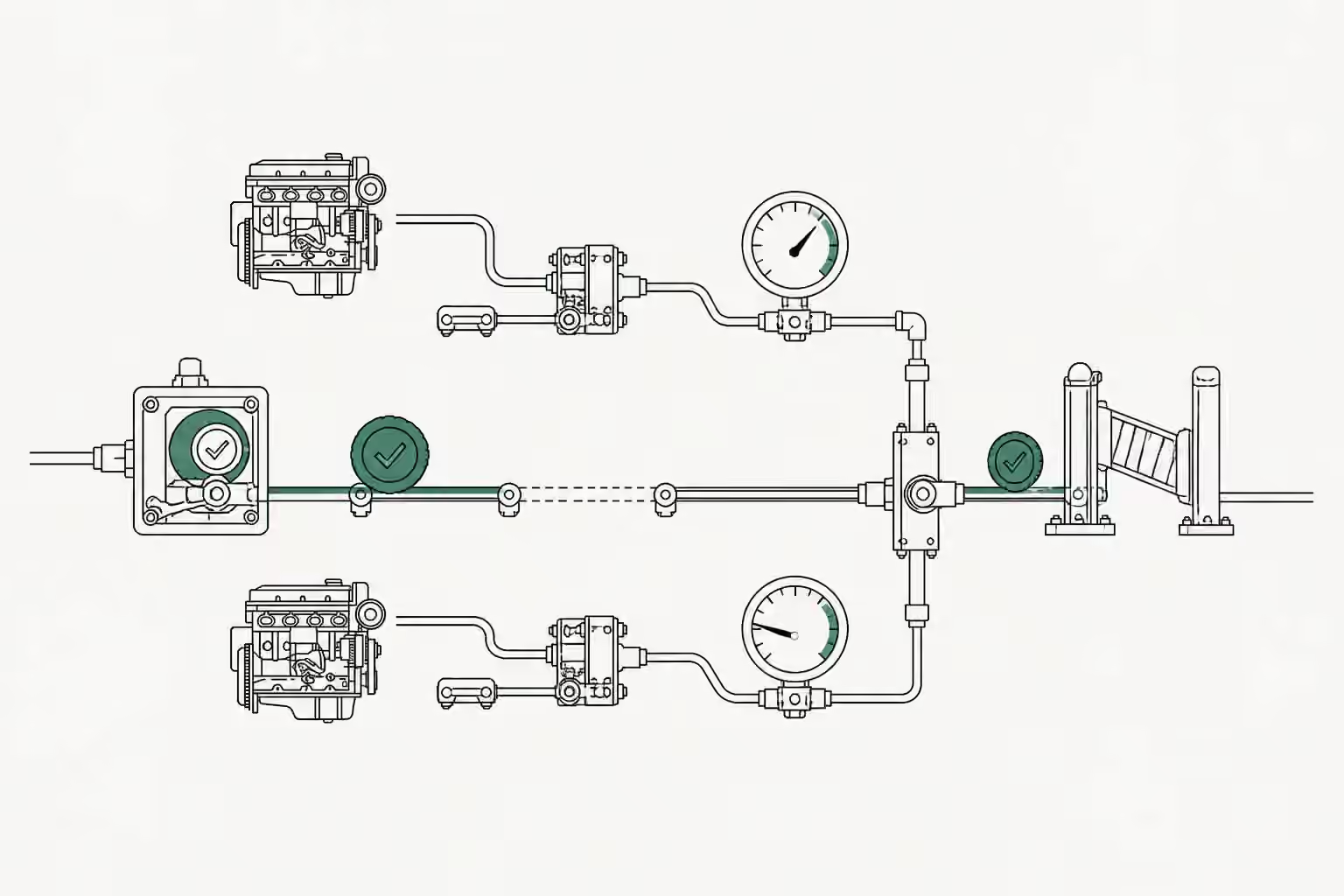
An approval holds only against the state it read. If a shared budget, inventory count, approval status, or risk signal moves, yesterday’s clearance cannot govern today’s effect.
Yuxiang Peng and Xiaodi Wu name this failure stale authorization. A check clears an action from one view of policy state. Another task changes that state before the action takes effect. The old answer survives, but its reason does not.
Concurrent means that separate tasks can make progress during the same period. Their work can overlap even when each task follows its own ordered steps.
Judge the effect against the state that reaches it
The paper defines policy-state serializability in practical terms: every committed effect must have authorization under the policy state immediately before it occurs. In plain words, the gate must explain why the action remained allowed when it landed.
This condition does not require every task to stop behind one global queue. It requires shared policy facts and effects to take one explainable order. A delayed approval may remain valid while unrelated work proceeds, provided that work does not invalidate its policy basis.
That distinction separates this failure from two neighboring cases. An activity log cannot replace a release control because a later record cannot stop an earlier effect. A cleared step does not clear the sequence because permitted actions can still combine into a prohibited result.
Here, one gate ran and cleared one action. Shared state then moved beneath that decision. The release control must detect that change before the effect commits.
The prototype closes the stale window
MasuGate keeps policies as reviewable programs and coordinates their state with the effects they govern. A transaction is a group of database changes that succeeds as one unit or leaves no partial result.
In experiments, the PostgreSQL-backed MasuGate prototype prevented stale authorizations that request-context baselines missed. It also preserved a delayed approval while unrelated work proceeded.
The authors tested a scripted procurement workflow over shared budgets and inventory, with no model in the workflow. Their prototype produced no policy violation there, while the baselines produced stale authorizations.
The paper reports no production adoption. Its abstract gives no measurement counts or rates. No paper author is a Muniment customer or endorser.
Muniment’s position is that an approval record needs more than the policy answer. It must bind that answer to the policy state and reject it after relevant state changes.
Join the waitlist if your release records need to show why an approval still held when its effect landed.