An activity log is not a release control
Harness Agent DLC separates records of agent behavior from evaluation gates, governed releases, rollback, and policy checks that act in time.
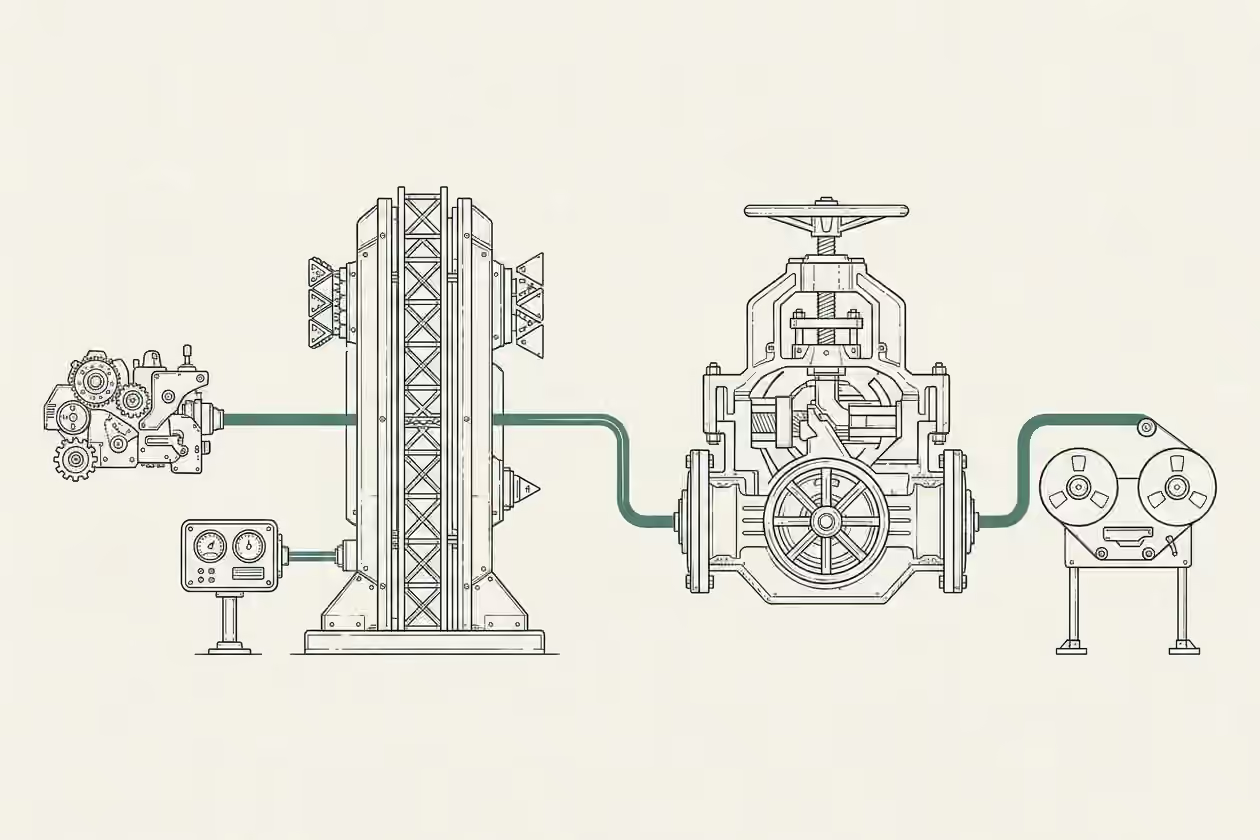
An activity log arrives too late to control a release. It can explain the path after an agent acts. It cannot reject a weak version before deployment or stop a forbidden action in flight. Harness Agent DLC offers public evidence for this separation because its announcement puts evaluation, deployment, live policy, and tracing at distinct stages.
Here, an agent means software that completes tasks and takes actions by choosing models, tools, and execution steps. Those choices can change from one run to another. A useful release system must govern both the version that enters production and the choices that occur there.
A release needs controls that act in time
Harness says its evaluation service tests a changed agent or model against defined datasets and scores correctness, performance, and safety. Teams can use those scores as quality gates in a delivery pipeline. This control can catch a regression before the release proceeds.
The announcement says its deployment service extends staged rollout, automated rollback, approval gates, and policy guardrails to managed hosting services. Harness names Amazon Bedrock AgentCore and Google Agent Runtime. A runtime is the managed environment where agent software runs. A release can remain in the governed pipeline instead of moving into a separate cloud workflow.
Harness also describes prompt and model changes that take effect without a redeploy. Operators can target a change, compare its effect, promote it, or roll it back. A prompt change still alters production behavior even when the application artifact stays fixed. It needs release discipline of its own.
These controls occupy different moments:
- An evaluation gate judges a candidate before promotion.
- An approval or policy gate decides whether the release may proceed.
- A staged rollout limits exposure while evidence accumulates.
- A live policy check constrains actions during execution.
- A rollback restores a known version after a bad signal.
A record written after an agent acts cannot replace a gate that runs before release or a policy check that runs during execution.
Inventory defines what the gate governs
A gate cannot govern an unknown object. Harness says its catalog discovers agents, skills, and plugins across source repositories, then links each item to an owner and its dependencies. That inventory gives a release decision a subject, a responsible person, and a dependency boundary.
The same announcement describes scans of prompts, skills, and packaged models before deployment. It also names a parts list for models, tools, and dependencies plus adversarial and policy testing. After release, Harness says posture management maps active agents and their connections. A policy check runs continuously against prompt injection, tool misuse, and data exfiltration.
That sequence matters. Inventory and testing constrain the candidate. Approval and rollout constrain entry. A live check constrains execution. Each control can change what happens next.
A trace supports a decision but cannot make it earlier
Harness AgentTrace records one agent run and a multi-step session. A trace is the ordered record of the path an agent took through prompts, model calls, tools, and outputs. Harness says teams can use that record to find failures, compare behavior across prompts and models, and supply an audit trail.
That record has real value. It can expose a failure or supply the signal for rollback. Its timestamp still matters. Observation can inform the next decision. It cannot retroactively turn an ungoverned action into a governed one.
Harness is public evidence and neither a Muniment customer nor an endorser. Its announcement describes product capabilities, not measured reductions in incidents, release failures, or review time. The evidence supports an architectural boundary: retain the trace, but put authority where it can still alter the outcome.