Agent teams move inside the system of record
Oracle’s Fusion builder announcement packages specialized agent teams with the permissions, approvals, workflows, and action logs of the host system.
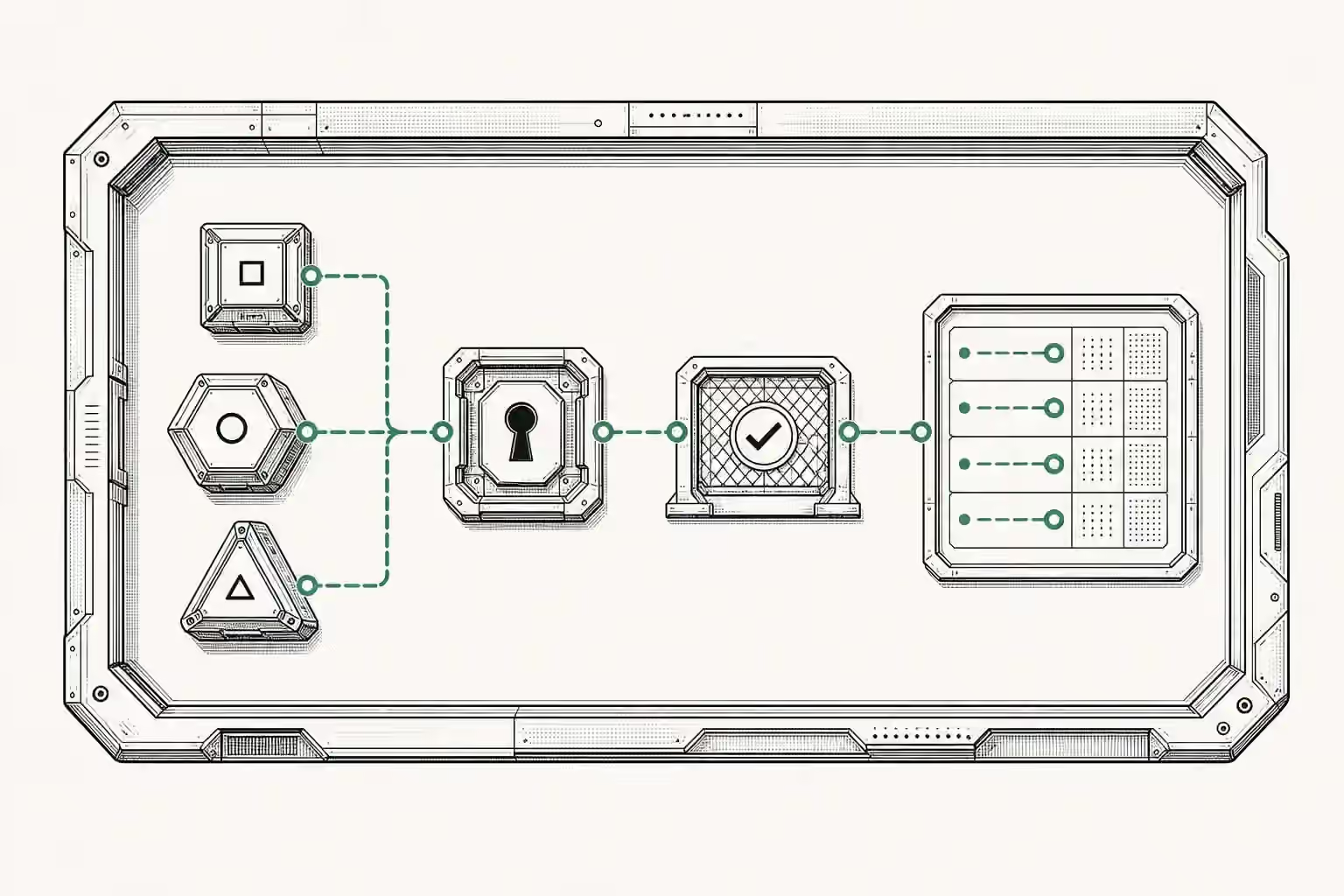
Agent teams are moving inside systems of record because that is where production autonomy can inherit a real control plane. Oracle’s new Fusion builder announcement puts specialized teams in the same runtime as business objects, permissions, workflows, approvals, and action logs. The package matters more than the agents. It makes governance part of execution instead of a review layer added after deployment.
The runtime carries the rules
Oracle says its Fusion Agentic Applications are backed by specialized agent teams that coordinate and decide, then execute through Fusion business objects, workflows, tools, policies, approvals, and logged actions. The announcement also says these applications run inside Oracle Fusion Applications, where they inherit the product’s security and governance controls.
That architecture gives an agent team the limits already attached to the work. Identity and data access come from the host system. A workflow can require an approval before a consequential step. Logged actions leave a trail in the same operational context as the objects they changed. Those are engineering consequences of the announced design, not evidence that every configuration will be safe or well governed.
Oracle announced one builder framework spanning natural-language, low-code, and pro-code development, with Visual Studio Code, standard command-line tools, Git workflows, local validation, debugging, and continuous delivery support. Different builders can enter through different tools while the resulting application lands in one governed runtime. The control boundary does not have to depend on which editor produced the code.
Interoperability stays inside the boundary
Oracle says its open execution system can coordinate Oracle, partner, third-party, and custom agents within Fusion security and governance controls. The company also says support for agent-to-agent interoperability lets external and custom-built agents participate with the same capabilities as Fusion Agentic Applications.
Interoperability usually expands the trust surface. Here, Oracle is packaging it as another route into the host system’s policy boundary. That is the useful pattern: accept agents from several origins, but make their authority legible where the business action occurs. An external agent should not arrive with a private definition of who may read a record, approve a payment, or alter a workflow.
Availability is not adoption evidence
Oracle presents the builder capabilities and integrations as available updates and says its agent studio is available to Fusion Applications customers and partners at no additional cost. This is first-party product evidence. The announcement provides no independent adoption data, production reliability measurements, security evaluation, or customer outcome study for the new builder experience.
Oracle is neither a Muniment customer nor an endorser. Its public announcement supports a narrower conclusion: a major system-of-record vendor now treats permissions, approvals, and action logs as the native habitat for agent teams. The unanswered question is whether operators will test those inherited controls as rigorously as the applications now depending on them.